

I Was Wrong About Running
overcoming a lifelong suspicion of an unnatural and deviant behaviour

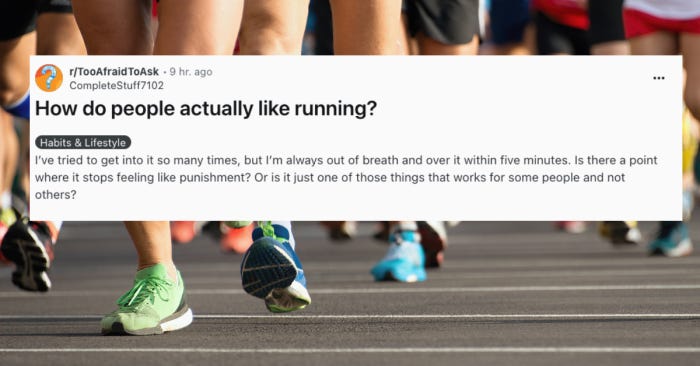
YEAH SAME QUESTION AS OP. The mere existence of running as a ‘hobby’ has always seemed like an affront to the dignity of mankind. It feels bad, and its practitioners make it look even worse: flailing around in their big marshmallow shoes, arms and legs and elbows spilling out in every direction, trailing strings of spit and sweat. You have to assume there’s some big payoff for all that effort, but even after years of diligent pavement-pounding, you still end up with the physique of a half-sucked throat lozenge. Wheee.
Don’t get me wrong. I enjoy exercise and sports. Every once in a while—we’re talking probably single digits over my adult lifetime—I get a wild hair up my ass and try to go for a run. Every time, I go right back to thinking it’s only for masochistic freaks.
If you asked me to sum up my feelings about running in a single word, I’d have said that it’s unnatural.
So it is with no small amount of embarrassment that I report to you, having just completed an entire year of running consistently, that I was wrong. But not just garden-variety wrong. This is maybe the wrongest I’ve ever been about anything, ever, because I managed to get it perfectly ass-backwards.
See, as it turns out, if you were to ask the question ‘what are humans designed to do best?’, a very good answer would be: ‘running long distances’.
As anthropologist Joe Henrich explains in The Secret of our Success, we have a full suite of specialised running adaptations from head to toe, allowing us to tirelessly chase our prey across the savannah:
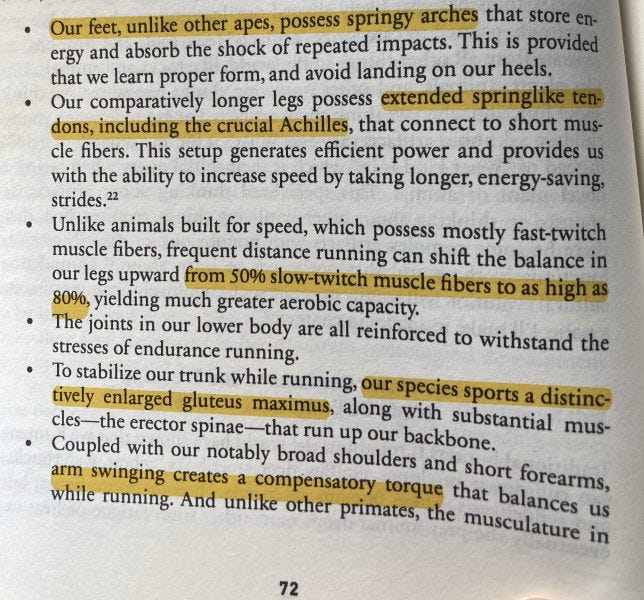
And so we’re good runners. But that’s understating it: we’re actually the greatest distance runners in all of God’s creation! Puny hairless humans, who get mogged by the animal kingdom on every other dimension of physicality! Turns out the one thing we absolutely fucking rule at is jogging along boringly for hours on end.
(The only animals better at covering long distances are horses, which we bred for that purpose so it doesn’t count, and wolves, whose furry little asses we would still kick if it was a hot day; plus they have twice as many legs so it’s not fair.)
Which leads to the question: why do non-runners find running so unnatural? How did I spend my entire adult life being so wrong about this?
Getting over the hater’s hump
A pattern of mistakes I keep making is dismissing popular things as stupid—sports fandom, fashion, various domains of aesthetics—simply because I don’t understand them or have no taste. There is a threshold of experience and knowledge required to get what all the fuss is about, and once you cross it, it becomes obvious that whoops, there really is a ‘there’ there. It still might not be your thing, but you have to get over the initial hump to be able to pass judgment.

In the case of running, most of the initial hump comes from the fact that it’s probably been a while since the last time you chased a gazelle across the savannah. On my first shuffling jog, I think I managed 3km. As expected, it basically sucked. The gazelles in the area slept soundly that night.
Then a couple days later I did 5km. Did it feel a little easier?
No, it did not. It felt much worse: I had to sit down in the road because I thought I was going to pass out.
So you have to give yourself some grace here. There’s this whole system lying dormant that, depending on how sedentary you are, is going to take some serious blowing-off-of-cobwebs. Of course it’s gonna feel like shit. And of course it’s gonna take more than two or three tries before it feels good.
The second factor is you have no idea what you’re doing, which makes getting over the hump much more difficult than it needs to be. In the case of running, there’s absolutely no need to go hard. If you ever feel like you’re going to pass out, you done goofed. The ideal approach is to go nice and slowly—walk breaks if necessary—build up your mileage week by week, and give your body time to adapt to the new stimulus.1
Anyway. I got over the hump, and found out I was wrong about running. One year in, I’ve got ~2500km in my legs, completed a marathon and a bunch of shorter races, and have more pairs of shoes in my wardrobe than peak Carrie Bradshaw.
I still don’t love every run, but when you’re covering the ground well, it really is something special: the sheer sense of joy in seeing what your body is truly capable of.
In that spirit, here a bunch of other things that have surprised me in my first year of running—not that I necessarily had strong opinions about before, but that made me go ‘huh’.
Everything from the mile to the marathon is the same thing
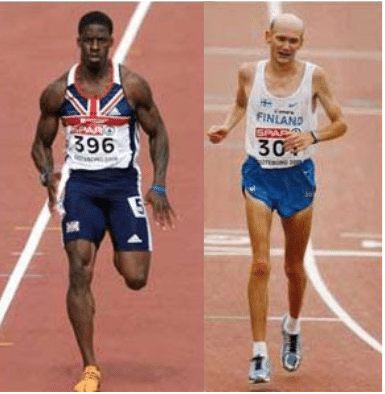
I knew that sprinters are insanely jacked. And I knew that marathon runners look like reanimated skeletons.
In between, I imagined a smooth gradient of physiques specialised to the different distances and their particular demands on the body. Instead, it looks like this:
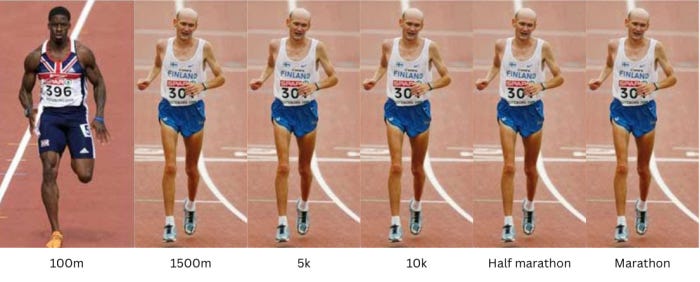
Running is all pretty much one sport, where the name of the game is ‘who can fit the most efficient aerobic engine on the smallest chassis’. That makes intuitive sense for the marathon, where over 99 per cent of the body’s energy needs are met by the steady chugging of the aerobic system. But even the mile—an incredibly intense burst of a few minutes—is something like 80 per cent aerobic. Big expensive muscles just don’t contribute that much, which is why elite runners are all built like birds.2
Professional runners specialise in certain distances, but it’s not unusual to transition from one event to another, and the foundations of their training are extremely similar. An elite miler would still place in the top ~0.1 per cent of marathon finishers, and vice versa.3
For amateur runners, who are all aerobically underdeveloped, there’s even less need for specialisation by distance. Whether you’re racing four minutes or four hours, the optimal training strategy is always to build up your aerobic engine.
Which leads to the next thing that really surprised me: if you want to get faster at running, you should spend ~100 per cent of your training running slowly.
You don’t have to run fast to run fast
Coming from the lifting world, I find this incredibly bizarre. If you wanted to increase your 1RM bench, it would be beyond pointless to spend all your time spamming hundreds of reps with the empty bar. Specificity is everything!
In the running world, it hardly matters at all. The metabolic adaptations that come from running slowly—mitochondrial density, capillarisation, lactate clearance—also translate to running fast.
You could bust your gut doing V02 max intervals and sprints. Or you could get in a lot of easy to moderate efforts without risking injury and burnout, and get the same (or better) results.
And so my 5k time has dropped from 27:xx to 19:xx over the course of the year without doing any speedwork at all.4
As far as I can tell, I should be able to stick with this approach more or less forever: it’s only once you get to the sub-elite level that you might need to do some specialisation and sharpening.
Drinking water is not as big a deal as I thought it would be
The marketing team at Yeti have convinced us, or at least our wives, that we must lug a comically oversized water bottle everywhere we go, and if we forget to take a sip every four minutes we will shrivel up into a desiccated husk and blow away in the wind.
Fake news!
The human body is designed to lose 2 or 3 per cent of its bodyweight in sweat, which is a hell of a lot—picture a big 1.5 litre jug sloshing with sweat, or actually, on second thought, don’t—without impairing health or performance. On race day, far more people get into trouble from drinking too much water (hyponatremia) than they do from not drinking enough.
You do need to replace the fluid and electrolytes lost, but it’s generally fine to do so once you’re done running; the exceptions being when it’s really hot, you’re a heavy sweater, or it’s a very long run. Most of my runs are only an hour, so I just have a glass of water before I set out and then rehydrate properly (i.e. with electrolytes) when I get home.
You really can outrun a bad diet (sort of)
I am a glutton who firmly believes in having at least one treat every day. This is a non-trivial reason for why I like lifting: there are metabolic advantages to carrying muscle mass that make it much easier to indulge yourself guilt-free.
One of the reasons I historically thought running was for suckers is that it not only lacks those metabolic benefits, but doesn’t even burn many calories. You could go work your ass off running 5km around the neighbourhood, and then undo all your work by eating one measly muffin.
But I have to admit that once you start racking up some decent mileage, you do get a pretty big bump in your calorie budget. During marathon training, my daily energy needs got close to 4000 cals. Not only was I eating a lot by sheer volume, I was able to take in quite a lot of those calories as pure junk.
Do you know what the ideal fuel for running is? They will try and tell you that you need to choke down sachets of overpriced Goop TM but the real answer is: plain old sugar, in whichever form you find most delicious.5
While eating lots of food is fun, I still don’t think running is a great fit for weight loss, and I sure wouldn’t want to be training for a marathon in a calorie deficit.
Running has the lowest floor and the highest ceiling of any sport
Crossing the finish line of my first race, I experienced a moment of genuine culture shock as the volunteers draped a medal around my neck. Had they mistaken me for one of those Make a Wish kids or something?
I have since learned that it’s completely routine for grown adults to be presented with a shiny ‘finisher’ medal for completing a fun run, regardless of the distance, what time they ran, or even if they ran at all. I still find it hard to get my head around this, but the running world is aggressively inclusive in a way which defies parody: you genuinely could not come up with a feat too trivial to be celebrated.

Again, this is unthinkable in any other context. You rock up to a powerlifting meet, struggle to perform a single repetition of the empty bar, and everyone cheers as you receive your medal. What’s going on here?
I think the explanation is mostly:
a) running is often the first introduction to exercise for many people, and
b) major races are open to everyone, in a way which is completely unlike any other sport.
Everyone talks about wanting to put an average schmuck in the Olympics, but road running is ahead of the game: you can already watch the greatest marathoners in the world chasing down the two hour record, while a TikToker limps their way over the finish line five hours after the race is over, posting their medal selfie with the caption ‘ran a marathon with no training’ to much yasskweening in the comments about how you beat EVERY SINGLE PERSON who stayed home on the couch, etc.
The delta is ridiculous because you have actual god-tier athletes mixing it up with everyone from very serious hobbyists to people who are taking the first baby steps on their personal fitness journey. Best not to play the game of who is ‘really’ a runner, especially when it’s that latter group who are paying the bills!
Anyway, I do think the inclusivity is (for the most part) a good thing. It’s great that people are chasing any kind of exercise goals. But you have to admit the medals are pretty funny.
The one thing I HAVEN’T changed my mind about
…is that running is an inherently goofy activity. Every time I see another person out jogging I think ‘oh god do I look like that’.
I have a strict policy of averting my eyes whenever I run past reflective surfaces. I must maintain the illusion that I look cool and graceful. If I ever have the misfortune to see a video of myself, that’ll be the end: I will have no choice but to hang up my big stupid marshmallow shoes forever.
Pour one out for my friend who started running at the same time as me, hurt his knee after flogging himself on his second-ever run, and is still limping to this day.
They’re also short! Naively you’d expect tall people with long legs to run way faster than manlets, but scaling laws work against them: worse heat dissipation, higher relative metabolic needs.
A fun example: Eliot Kipchoge runs his marathons at a faster pace than I could reach in a 100m all-out sprint.
I still do some moderately fast stuff around half marathon pace (in heart rate terms, zones 3-4) but never cross the lactate threshold (i.e. into zone 5). The great bulk of my running is very easy zone 1 shuffling.
The state of the art is to consume fructose and glucose in a 0.8 : 1 ratio, meaning that the engineers have now circled almost all the way back to literal table sugar (sucrose), which has a 1:1 ratio. There are some slight advantages to consuming free fructose/glucose at very high intakes, but not in a way that’s relevant to hobby joggers.
As someone that did track and field but despised long distances because of shin splints, you may have convinced me to try working up to running very slowly